

We rebuild websites every month, and a lot of them have the same story behind them: they were built cheaply the first time. It might be a template that hit its ceiling, a freelancer who moved on, or a site built down to a price it could never live up to. The owners rarely chose badly on purpose. They chose the route that looked right at the time, before they knew how much the website would come to matter.
So before you pick between a website builder, a freelancer and an agency, it helps to know what putting those sites right has taught us. The deciding factor is almost never which one is cheapest. It is two questions most people skip: how much does this website really matter to your business, and how much of the work and the risk are you prepared to carry yourself?
We are an agency, so you would expect the answer to be "hire an agency". It is not, or not always. For plenty of businesses a builder or a freelancer is exactly right, and we say so when it is. What follows is the straight version, including the parts most agencies leave out, drawn from what we see when these projects come to us to be rebuilt.
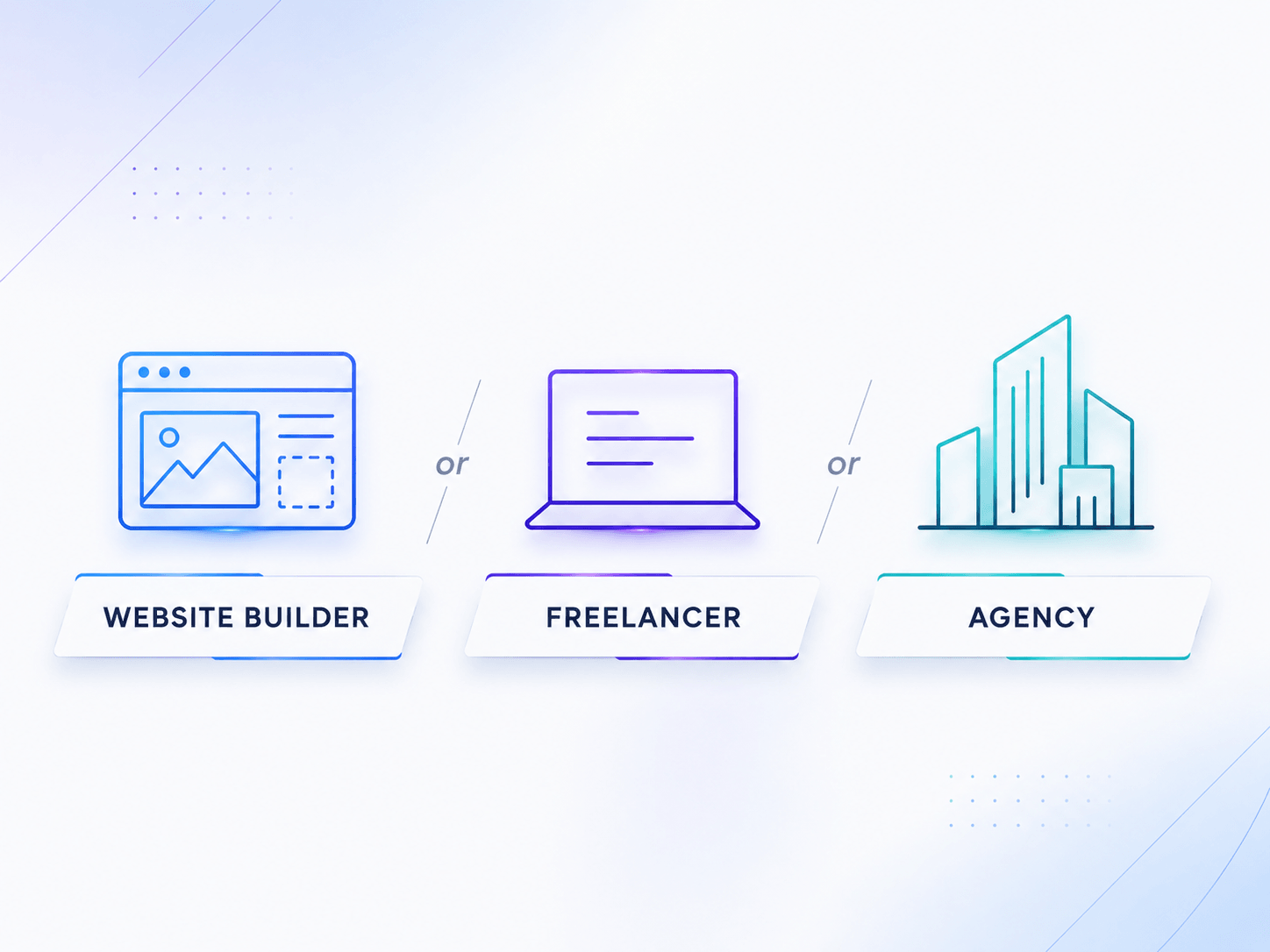
Website builder, freelancer or agency: the short version
| Website builder | Freelancer | Agency | |
|---|---|---|---|
| Best for | Brand-new or very simple sites on a tight budget | Small, well-defined projects you can manage | Websites that matter to the business and must perform |
| Typical cost | Around £10 to £30 a month, plus your time | A few hundred to a few thousand pounds | Often two to three times a freelancer |
| What you get | A template you build and maintain yourself | One person, direct and flexible | A team: design, build, SEO and support |
| Main risk | Hits a ceiling as you grow | Everything rests on one person | Higher cost up front |
| After launch | You are on your own | Depends on the individual | An ongoing partner |
Each route can produce a perfectly good website for the right business. The mistake is rarely picking the cheap option. It is picking the option that does not match how much the website needs to do.
When is a website builder the right choice?
A website builder like Wix, Squarespace or Shopify lets you build and run a site yourself from a template, for a low monthly fee. For the right business that is a sensible place to start, not a compromise: when you are new and testing an idea, when the site is a few pages or a small shop, and when the budget is tight.
The version we see go wrong is usually the same. The site does its job for a year or two, then the business grows into something the template was never built for. The week we tend to get the call is the week the owner tries to add the thing that finally will not fit: online ordering the theme cannot support, a booking system that only works through a clunky add-on, a link to their accounts software the platform simply will not allow. Nothing has failed, exactly. The site has run out of room, and so has the patience for working around it.
There is another gap too, and it is the one people underestimate. A builder hands you the tools, not the know-how to use them well. The template will let you publish a page, but it will not tell you where to place a call to action, how to structure the site so visitors find what they need, how much to write on each page, or how to give Google a reason to rank you. Search visibility especially is rarely handled for you out of the box: you either learn it, or you end up with a site that looks the part but never gets found. That is the part that catches people out, because you do not know what you do not know until the enquiries fail to arrive. A good freelancer or agency brings that judgement with them, and it is often the difference between a site that looks nice and one that brings in work.
So a builder is a fine first step if you are starting out, watching the budget, and happy to own the upkeep. The signal to move on is not a redesign itch. It is the first time the site starts costing you customers rather than winning them.
When is a freelancer the right choice?
A freelancer is one skilled person you hire for the project. For a small, well-defined brief a good one can be excellent value: lower cost than an agency, a direct line to the person doing the work, and the ease of dealing with a single individual. For the same brief an agency usually costs more, often two to three times as much, so for a straightforward site a freelancer can stretch a smaller budget a long way.
The risk is the one nobody prices in until it arrives: everything rests on one person. The pattern we are called in to fix is the freelancer who goes quiet halfway through, the site left half-built when a bigger contract comes along, the owner sitting on a login and an unfinished theme with no one left to ask. It is rarely bad faith. A freelancer who lands a full-time role or a larger client has to follow the work, and your project is the one that waits. Quality varies enormously between freelancers too, and once the final invoice is paid, support is often whatever goodwill remains.
If the project is small, clearly specified, and you are comfortable managing it and carrying that single-point-of-failure risk, a good freelancer is a strong choice. Just go in with your eyes open about what happens the day they are no longer there. For an online store specifically, our Shopify agency, freelancer or Fiverr guide covers the collaborator-access and continuity questions in detail.
When is an agency the right choice?
An agency is the right call when the website is a real asset to the business: when it has to be found, turn visitors into enquiries and sales, and keep working as the business grows. What you are paying for is a team rather than a single person. Design, development, SEO and content sit under one roof, there is no single point of failure, and someone is accountable for the result and still there after launch. That continuity is the point, because the average website converts only a small share of its visitors, often around 2 to 3%, and closing that gap is steady design and build work, not luck.
Not every agency is the same, though, and the difference is worth knowing. A large, traditional agency often means layers: your project handed between account managers, a chain of people sitting between you and the work, and a real slice of your budget going on the overhead of a big team. A smaller, modern studio works differently. You deal directly with the team responsible for your project rather than a queue of account managers, decisions happen quickly because there is little to pass through, and you pay for the work rather than the layers. That is how we work, and for most growing businesses it is the better value of the two.
The trade-off is cost: an agency is the most expensive of the three up front. The case for it is not the price tag but the return, a site built once, properly, that earns its keep instead of needing doing again. We break the numbers down in our guide to UK website costs.
What does each really cost over time?
The sticker price is the smallest part of this decision. The number that matters is what the website costs you over a few years, and on that measure the cheapest option up front is often the dearest in the end.
A builder is cheap to start but costs you your time, and a rebuild once you outgrow it. A freelancer sits in the middle, the hidden cost being the risk: a project that stalls, or a site no one can support later. An agency costs the most at the outset and the least in nasty surprises, because it is built once to last and someone is there to keep it running.
This is the false economy we watch play out most often. A business saves a few thousand pounds on the first website, then spends more than that putting it right eighteen months later. The saving was real on the day. It simply did not survive the first time the site had to do something it was never built for. A cheap website that loses you customers is far more expensive than a good one that wins them, whatever the invoice said.
So which one does your business really need?
Here is the decision in three lines:
- A website builder if you are brand new or very simple, the budget is tight, and you are happy to build and maintain it yourself.
- A freelancer if the project is small and well-defined, you can manage it, and you accept that everything rests on one person.
- An agency if the website matters to the business, needs to perform, and you want it handled by a team that is still there after launch.
If you are torn, the deciding question is not "what can I afford?" It is "how much does this website matter to my business, and how much of the work and risk do I want to own?" Answer that one truthfully and the right route is usually obvious.
The cheapest website is rarely the one that costs you the least. The business that saves on the first build often spends more putting it right than it would have spent doing it properly once. The question worth asking is not what a website costs, but what a website that does not work is costing you.
- Miles Debinski, Co-Founder & Technical Lead at Digital Otter
None of this is a pitch for always hiring an agency. For a brand-new or very simple site, a builder or a good freelancer may be exactly right, and we will tell you so. An agency earns its place when the website is a real asset to the business and you want it built to perform and properly looked after.
If you would like a straight answer on which route fits your situation, we are happy to talk it through, and we will be honest if a builder or a freelancer is the better call. Tell us about your project, see some of our recent work, or read about how we approach web design in Cumbria.
Related Posts



Get in touch - we're happy to chat.