

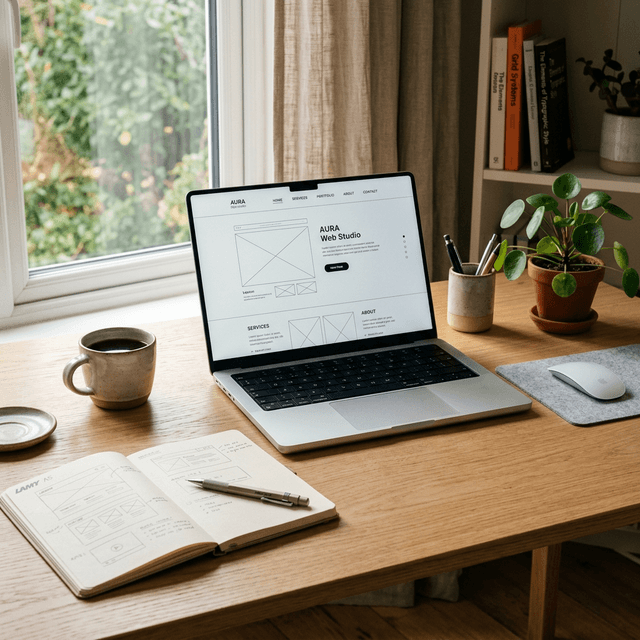
Why Custom Web Design Matters: Moving Beyond Templates for True Brand Growth
Off-the-shelf website templates are quick to set up, but they often struggle to scale. Discover why investing in custom, bespoke web design is essential for building authority, driving conversions, and future-proofing your business.
When launching a new business or refreshing an online presence, the temptation to use an off-the-shelf website template is entirely understandable. They are quick to set up, visually appealing at first glance, and often require minimal upfront investment.
However, as a business grows, the limitations of templates quickly become apparent. From sluggish performance to restrictive layouts that fail to represent your unique brand, what seems like a cost-effective solution can inadvertently slow down your growth.
At Digital Otter, we’ve seen businesses hit a wall with template-based sites. Here’s why investing in custom web design makes a tangible difference to your long-term success, search engine authority, and user engagement.
What Actually Makes a Website "Custom"?
There is a common misconception that "custom web design" just means choosing unique colours, fonts, and images. While visual branding is crucial, true bespoke web design goes much deeper.
A custom website is built from the ground up around your specific business goals, user journeys, and operational needs. It means:
- Purpose-Driven UX/UI: User interfaces designed specifically for your target audience, not a generic catch-all demographic.
- Clean Code Architecture: Unlike templates packed with unnecessary features and bloated code, a custom built site contains only what it needs, ensuring lightning-fast performance.
- Seamless Integrations: Tailored connections to your CRM, booking software, or inventory management without relying on clunky third-party plugins.
The SEO Advantage of Bespoke Web Design
One of the biggest hidden costs of cheap templates is their impact on Search Engine Optimisation (SEO). Search engines like Google prioritise websites that are fast, mobile-friendly, and structurally sound.
1. Speed and Performance
Templates are often built to be "one size fits all", packed with heavy sliders, generic scripts, and complex style sheets that your site might not even use. This bloat severely impacts loading speeds. Custom web design (whether it's a headless Next.js build or a carefully tailored Shopify or WordPress theme) ensures a lean, performant codebase that Google rewards.
2. Tailored Site Structure
A custom website allows for a perfectly planned site architecture and URL structure. This strategic hierarchy makes it easier for search engines to crawl and index your pages, helping your core services and complementary content rank higher.
A well-structured site also supports internal linking - the practice of connecting related pages together in a logical way. This distributes authority across the site and helps Google understand the relationship between your content, which template-based sites often handle poorly or inconsistently.
3. Schema and Structured Data
Custom-built websites make it far easier to implement schema markup - the structured data that tells search engines exactly what your business is, where it is located, what services you offer, and what your customers say about you. This data feeds directly into rich results like star ratings, business information panels, and FAQ listings in search. Most templates either do not support schema at all, or offer limited control over what is included and how it is structured.
Scalability and Future-Proofing
Your website should be an asset that grows alongside your business, not a static brochure that needs completely replacing every two years.
When you rely on out-of-the-box templates, adding unexpected new features, like a bespoke booking portal or a newly structured ecommerce offering, can quickly turn into a development headache. In contrast, a custom-built website has scalability inherently built into its DNA. Developers can easily scale server resources, add new custom post types, and evolve the design system without compromising the site's stability or speed.
Brand Perception & Trust
In the digital space, first impressions form faster than most people realise. Research by Lindgaard et al. (2006) found that users form a visual impression of a website in as little as 50 milliseconds - and that initial reaction strongly influences whether they stay or leave. Users are increasingly savvy, and a site that looks remarkably similar to thousands of others using the same template can subconsciously erode brand credibility.
A beautifully crafted, custom website signals professionalism, longevity, and quality. Small details, from tailored micro-interactions to thoughtful white space and typography, elevate the user experience. This premium feel keeps visitors engaged longer, reducing bounce rates and ultimately driving higher conversion rates.
The Real Cost of Templates Over Time
The upfront cost of a template-based website can look attractive, but it rarely tells the full story. Over time, the economics often shift in favour of a custom build. Our guide to how much a website costs in the UK puts real numbers against both options.
Consider what template-dependent businesses typically encounter as they grow:
- Plugin and theme licensing fees that accumulate month on month, often covering functionality that a custom build would include natively.
- Developer workarounds when a template cannot do what the business needs - paying someone to fight a template's constraints is rarely efficient.
- Performance degradation as more plugins are added, each one introducing additional scripts and slowing the site further.
- The inevitable rebuild. Most businesses running a template-based site outgrow it entirely within two to four years and face a full rebuild anyway, negating much of the original saving.
A custom website, by contrast, is built to accommodate growth from day one. The architecture is designed to evolve - adding a new service section, an ecommerce layer, or a client portal is a planned extension rather than a structural problem.
This does not mean every business needs the most complex custom build possible. A good web design agency will be honest about what level of investment makes sense at each stage of growth. The goal is a site that serves your business well now and does not need replacing prematurely.
Is Custom Web Design Right for You Right Now?
Templates are not inherently bad. For a brand-new business testing a concept, a well-structured template site can be an entirely sensible starting point. The issue arises when businesses keep outgrowing their template rather than making the move to something built for their actual needs.
Custom web design typically becomes the right investment when:
- Your website is generating meaningful traffic but conversion rates are disappointing - pointing to a UX or trust issue rather than a visibility one.
- You need integrations, booking systems, or ecommerce functionality that does not fit cleanly into a template framework.
- Your brand has evolved and your website no longer reflects where the business actually is.
- You are investing in SEO or paid media and need the underlying site to perform well enough to make that spend worthwhile.
- Your competitors are investing in their digital presence and the gap is starting to show.
If you recognise any of these signals in your own business, it is usually a good indicator that the return on a custom build would outweigh the cost relatively quickly. The websites that generate the most enquiries and revenue are rarely the ones built on the cheapest available template - they are the ones built with genuine intent around the customer and the business goal.
When evaluating a web design partner, look for agencies that ask about your business goals and customer journey before they talk about design or technology. The platform choice and visual direction should follow from a clear understanding of what the site needs to achieve - not the other way around. A good brief produces a good website. Asking the right questions upfront is one of the clearest signals that an agency will build something that actually works for your business rather than just looks good in a portfolio screenshot.
Conclusion: An Investment, Not an Expense
While templates offer a shortcut to getting online, they often place an invisible ceiling on a brand's potential. Custom web design is an investment in your brand's digital foundation. It prepares your business to compete at a higher level, ensures you are memorable, and gives you a platform engineered specifically for your success.
The businesses that tend to get the most out of a custom website are those who treat it as a long-term commercial asset rather than a one-time project. A well-built site should be getting more valuable over time - accumulating search visibility, refining its conversion rate, and adapting to how the business evolves. That kind of compounding return is simply not possible within the constraints of an off-the-shelf template.
If you are ready to elevate your digital presence and build a website tailored exactly to your ambitions, explore our Web Design Services or get in touch below. We specialise in turning complex requirements into beautiful, high-performing websites.
Related Posts


Get in touch - we're happy to chat.