

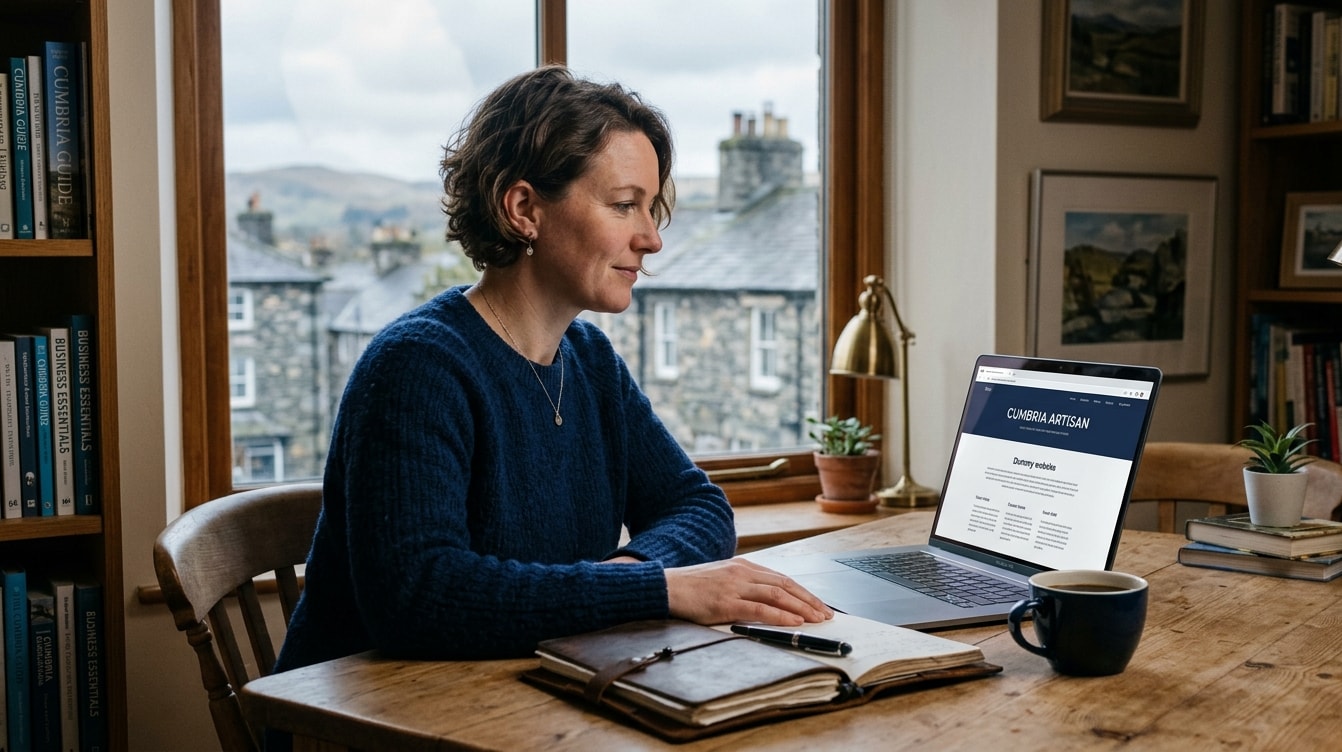
When you run a business in Kendal, your website is doing more work than most people realise. The high street is a daily visitor for most locals and word travels fast, but word-of-mouth has limits. It stops at the people who already know you exist. Everyone else, the ones who could become your next ten customers, finds you the same way they find everything else now: a search bar.
That makes choosing the right web designer one of the more consequential decisions a Kendal business will make this year. The wrong choice gives you a site that looks fine and underperforms quietly for two years. The right choice gives you a dependable engine that brings in enquiries while you sleep.
This guide walks through what to look for, what to ask, and what to avoid.
Why Where Your Designer Is Based Actually Matters
The web design industry sells itself as borderless, and to a real extent it is. We work with clients across the UK and internationally, and we have built sites for businesses we have only ever met over Zoom. Distance is not the disqualifier it used to be.
That said, a Kendal-based designer can offer things a remote provider cannot fake. They understand what the high street looks like in February versus August, what your B&B's customers actually search for, which referrers convert in the Lake District. They are a short drive away if something breaks, and accountability tends to be higher when you have met in person in a café off Stricklandgate.
The honest answer is that local is one factor among several. It matters more for some projects than others. The sections below cover what matters in every case.
The Five Things Every Kendal Business Owner Should Evaluate
Web design quotes often look similar on the surface and very different in practice. The following five areas are where the real differences live. If a designer cannot speak clearly to all five, that tells you most of what you need to know.
1. Search & Visibility
Will your ideal customers actually find you online?
The single biggest mistake we see is treating SEO as something to bolt on after the site is built. By that point, the architecture is already wrong. SEO has to be baked in from day one - in how the site is structured, how content is organised, how pages load, and how Google understands what your business is.
Look for a designer who treats SEO as fundamental, not optional. They should be talking about Core Web Vitals, structured data, sitemap submission, and your Google Business Profile setup. They should be researching what your competitors rank for before they start designing pages. They should understand that AI search tools like ChatGPT and Perplexity are now sending real traffic, and that being citable matters as much as being indexable.
If "SEO included" appears in a quote without specifics, ask what specifically. The honest answer is detailed.
2. Design & First Impressions
Would a stranger trust your business at first glance?
The visitor decides whether to stay or leave in a few seconds. Custom design that reflects your business - not a reskinned template - signals that you take it seriously. What you do should be clear within five seconds. Navigation should feel intuitive rather than designed by committee. The site has to work properly on every device, because the majority of local searches happen on phones, and a site that looks fine on desktop but falls apart on mobile is losing customers you will never know about.
Web Content Accessibility Guidelines compliance is legally required for public sector bodies and for some private services such as ecommerce and banking, treated by Google as a quality signal, and good practice for any business that wants to reach all of its customers. A designer who does not bring this up unprompted is one who has not been paying attention.
3. Messaging & Copy
Will the words on your site actually sell for you?
Most websites are written about the business when they should be written for the customer. The designer or agency you hire should either handle copy themselves or work closely with someone who can. Look for sites in their portfolio where the writing speaks directly to the visitor's situation, rather than listing the company's awards.
Every page should have one clear next step. No filler, no jargon, no "innovative solutions tailored to your needs." Real businesses talk like real humans, and customers respond to that. If the copy in their portfolio sounds like every other agency, yours will too.
4. Ownership & Control
Will you actually own what you are paying for?
When the project ends, you should walk away with everything: the domain in your name, the code on your hardware, full admin access to the CMS, and the ability to edit content without paying for every change. No hosting locked to the agency. No proprietary platform that holds your content hostage. No ongoing fees that were not disclosed at the start.
The test is simple. If the relationship ended tomorrow, could you take everything to another designer with no friction? If the answer is no, the contract is not on your side. We covered some of the wider symptoms of this in our earlier post on the most common website mistakes we see - worth a read alongside this one.
5. Results & Accountability
Will this website actually help your business grow?
A website is supposed to do work. The question is what work, exactly, and how you will know if it is doing it. Look for a designer who installs analytics from day one, tracks form submissions and calls and bookings as real events, and walks you through the dashboard so you can see what is happening.
After launch, real designers stay involved. They monitor uptime, fix what breaks, and recommend improvements based on what the data shows. For ongoing growth work, a structured growth retainer tends to produce better results than ad-hoc fixes - more consistent attention, clearer reporting, and a more predictable monthly cost. A handover-and-vanish approach is the cheapest version of this work upfront and almost always the most expensive in the long run.
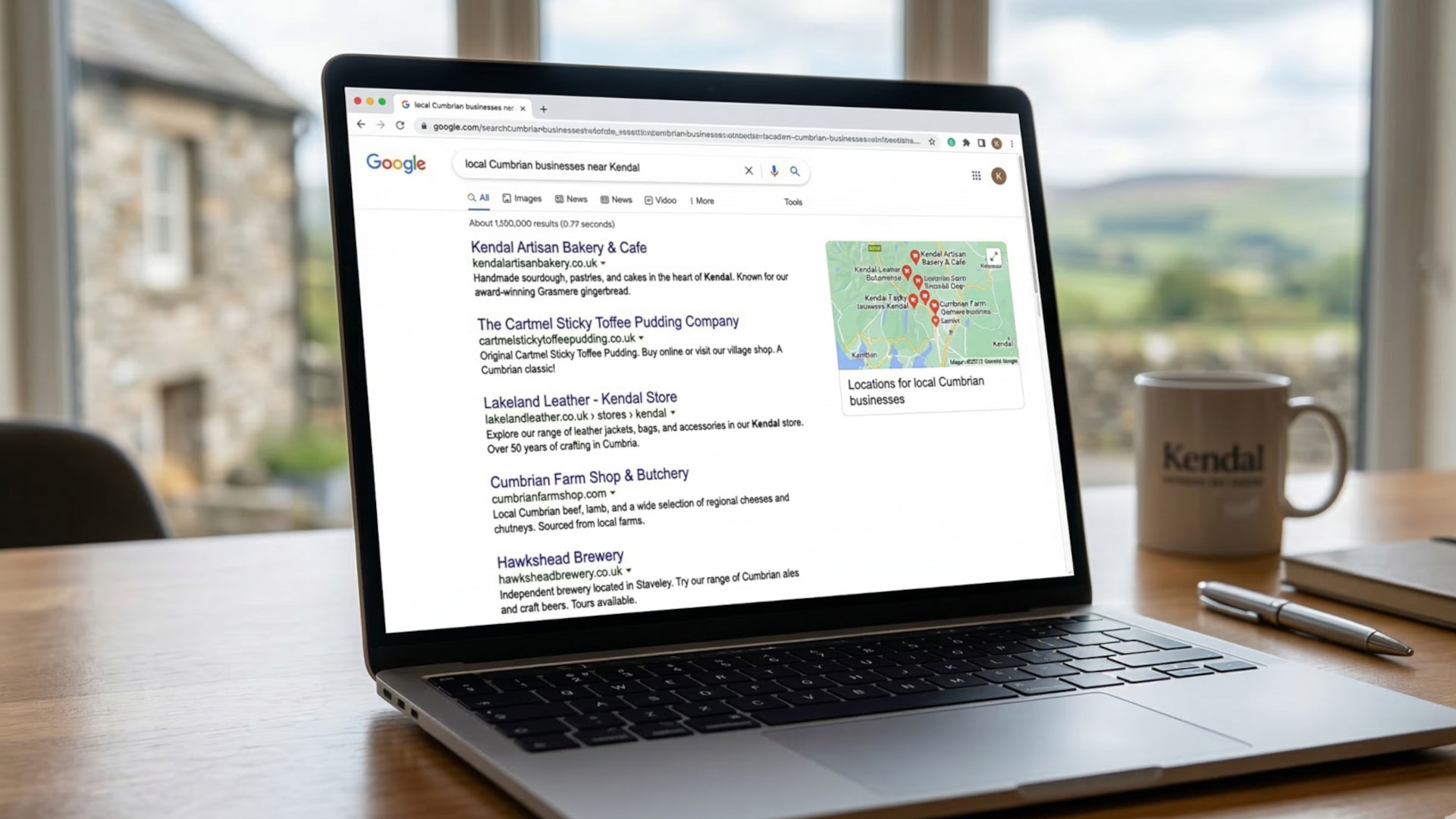
Local Agency, National Agency, or Freelancer: The Real Trade-offs
Each has a place. We are an agency based in Kendal, so we have an obvious bias, but it would be misleading to pretend local is always the right answer.
A local agency brings the things national agencies struggle to fake: face-to-face workshops, in-person handover, real working knowledge of Cumbrian customer behaviour, and being a five-minute call away when you have a question. The trade-off is depth in any one specific niche. A Kendal agency probably has not built dozens of healthcare booking portals or enterprise SaaS dashboards.
A national or city-based agency typically has deeper specialism, larger teams, and resources for very technical builds. The trade-off is account fragmentation. You often get assigned a junior account manager, your project sits in a queue behind much larger clients, and your invoice reflects a Manchester or London cost base.
A freelancer can be excellent for the right project. They tend to do brilliant work in a narrow lane - a beautiful Webflow site, a clean WordPress build - but struggle when the work spans disciplines. If your project has a single clear outcome and a tight scope, a freelancer might be perfect. If it doesn't, you will end up coordinating four of them yourself.
The right choice depends on what your business actually needs, not what the cheapest line item says. If budget is the open question, our guide to what a website costs in the UK breaks down the realistic ranges.
Red Flags Every Kendal Business Owner Should Watch For
Some warning signs are obvious. Others hide in friendly conversation. The ones we would tell our own family to walk away from:
- A portfolio without recognisable work. If they cannot show you live, performant sites that real businesses are actively using, treat that as data.
- No mention of search performance. A designer focused only on visuals is a graphic designer who has wandered into web work. A real web designer talks about how the site will be found.
- "SEO included" with no specifics. What does that actually mean? Keyword research? On-page optimisation? Schema markup? Local citations? Without specifics, "SEO included" usually means a robots.txt file and nothing else.
- A locked-in CMS or proprietary platform. If you cannot take your content elsewhere when the relationship ends, you do not really own your website.
- Templates dressed as bespoke design. Ask directly: "Is this built from a template, or from scratch?" The answer matters more than the price tag.
- No conversation about your customers. If they spend the whole call talking about themselves and their process, the site they build will do the same.
The Questions a Good Designer Asks You Back
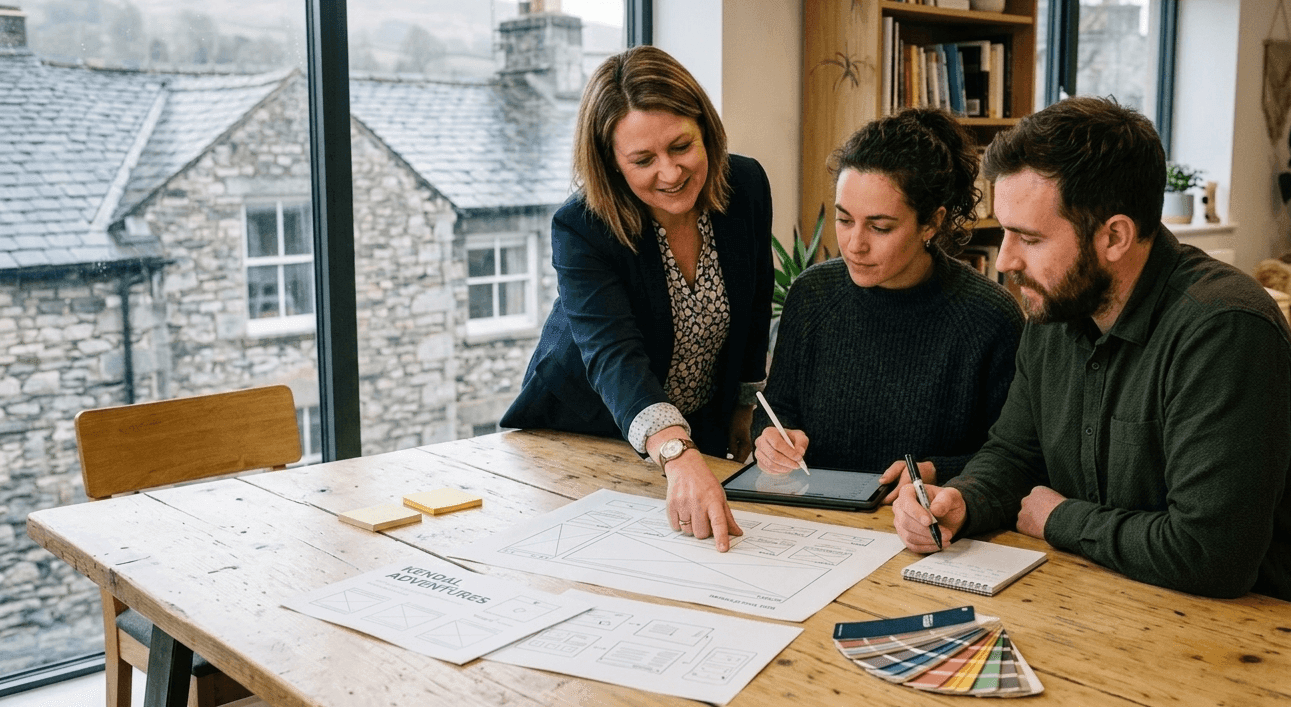
The conversation should not be one-way. A web designer who genuinely understands what they are building will turn the questions around within the first thirty minutes.
They will ask what your customers actually search for, not what you want them to search for. They will ask which of your services makes you the most money, and which you wish you sold less of. They will ask what your sales process looks like the moment an enquiry lands in your inbox. They will ask about seasonal patterns - when is busy, when is quiet, what changes between those two states.
If your designer is not asking these things, they are building you a beautiful brochure that does not know your business. That is the version that looks good in screenshots and underperforms for two years before someone tells you why.
Making the Right Choice for Your Business
The five areas above - search, design, messaging, ownership, and results - are the ones that decide whether a website earns its keep or quietly costs you for years. Add the red flags to your checklist, listen for the questions a good designer asks back, and pick the partner who can speak clearly to all of it.
If you would like to talk through what your business specifically needs - no pitch, no slide deck, just thirty minutes on the phone - you can book a free discovery call. We are a web design agency based in Kendal working with businesses across Cumbria, and we would rather help you make a good decision than win business that is not a fit.
Related Posts



Get in touch - we're happy to chat.