


Selling abroad is no longer an aspirational goal reserved for the biggest consumer brands. With the right setup, a UK ecommerce business can serve customers in Germany, the United States, Australia and beyond from the same website, with localised pricing, native-language content and stock pools that ship from whichever warehouse is closest. The hard part of ecommerce internationalisation is getting all of those moving parts to work in concert, and the brands that succeed treat it as a proper project rather than a checkbox on the back office.
Why internationalisation is on every ecommerce roadmap right now
The headline numbers explain the pull. The global cross-border B2C ecommerce market was worth around $551 billion in 2025 and is forecast to reach roughly $636 billion in 2026, growing at more than 15 percent a year through to 2034. Cross-border purchases now account for 44 percent of European B2C ecommerce turnover, and Shopify's analysis puts the wider global ecommerce market on track to clear $7 trillion in 2026.
Customer appetite is just as telling. CSA Research, surveying more than 8,700 consumers across 29 countries, found that 76 percent of online shoppers prefer to buy from sites with information in their native language, and 40 percent will not buy from sites in another language at all. A meaningful slice of your potential international customers will simply not convert from an English-only store, regardless of how strong your product is.
Pick your markets before you build for them
The biggest mistake we see is treating internationalisation as a switch rather than a sequence. It is not one market called "everywhere"; it is a deliberate set of decisions about which markets you serve first, and what the experience looks like in each.
Start with the data you already have. Where is unsolicited international traffic coming from? Which countries are converting despite paying in pounds and waiting longer for delivery? Existing analytics will usually surface two or three markets that are quietly outperforming on intent, and those are the right places to start. Pressure-test each shortlisted market against three things:
- Demand and competition. Is there genuine appetite for your product, and who already serves it locally? Strong domestic competitors are not a deal-breaker, but they shape pricing and positioning.
- Logistics and fulfilment cost. How quickly and affordably can you actually deliver? A market is only viable if you can hit a delivery promise local consumers will accept.
- Regulatory and tax burden. Some markets carry far heavier compliance weight than others. Selling into Germany is not the same as selling into Ireland, and selling into the United States brings sales-tax obligations that vary state by state.
Launching properly in one or two priority markets, learning from real data, then expanding from a position of strength is almost always the right approach.
Currency, pricing and local payment methods
Showing prices in a customer's local currency is one of the highest-leverage changes you can make. It removes the moment of cognitive load that mental currency conversion creates, and it signals that your brand has properly shown up for that market. On Shopify, multi-currency through Shopify Markets lets you either auto-convert from a base price or set deliberate fixed prices per market. The latter gives you proper control over margin and rounding.
Currency alone is not enough; payment expectations vary enormously by region. Local options worth investigating before launching anywhere new include:
- iDEAL in the Netherlands, where it dominates checkout share.
- Klarna and other BNPL options, with one survey finding that 55 percent of cross-border shoppers use BNPL for all or most of their online purchases.
- Invoice and SEPA-based payments in Germany, which carry far more weight than they do in the UK.
- Apple Pay and Google Pay, increasingly the default for mobile checkout in most markets.
Pricing strategy needs to flex by market too. A simple GBP price multiplied by the day's exchange rate produces awkward fractional prices and ignores local price sensitivity. Setting deliberate, properly rounded prices per market protects both margin and conversion.

Translation, localisation and international SEO
Translation and localisation are not the same thing. Translation converts words from one language to another. Localisation adapts the entire experience: imagery, examples, tone, units of measurement, date formats and product descriptions, so the site reads as native to that market.
For Shopify stores, the Shopify Translate and Adapt app is the practical starting point. It translates every customer-facing surface, including product pages, checkout and transactional emails, and lets you create market-specific variants where straight translation falls short. Used carefully, the combination of human review and AI-assisted translation produces output that is accurate and on-brand rather than the obvious machine output that erodes trust.
Translation also has a direct SEO benefit that often gets overlooked. Once your product pages exist in German, French or Italian, you become eligible to rank in local search results, and you stop competing exclusively with English-language sites for international keywords. To make this work, hreflang tags need to be configured correctly, and your URL structure (subfolders such as /de/ or /fr/, or country-specific subdomains) needs to be consistent and properly crawlable. Careful SEO work is what makes a translated site actually rank locally rather than disappear into the long tail.
A few practical localisation points that are easy to overlook:
- Sizing and measurements need to convert sensibly (a UK 10 to an EU 38, a US 8).
- Product imagery may need to change for some markets if it carries cultural connotations or features models that do not represent the local audience.
- Returns information, support hours and contact methods all need to be relevant for each region.
Tax, duties and how the website handles them
Tax is the section most brands underestimate, and the one most likely to derail a launch if you get it wrong. The basics: when you sell internationally, you are stepping into another country's tax regime, and someone (you or your customer) ends up paying the duties, import VAT and sales taxes that apply.
The EU picture is shifting noticeably during 2026. The Import One-Stop Shop (IOSS) scheme remains in place for VAT collection on B2C imports up to 150 euros, allowing non-EU sellers to collect VAT at checkout and remit it through a single registration. However, the EU has now agreed to abolish the 150 euro customs-duty exemption that historically let parcels under that value enter duty-free. From 1 July 2026, a flat 3 euro customs duty per item will apply to low-value e-commerce imports under 150 euros sold by IOSS-registered non-EU sellers, and the full removal of the exemption is expected once the EU Customs Data Hub is operational in 2028. The UK is heading the same way: HM Treasury confirmed in the Autumn Budget 2025 that the £135 customs-duty relief for low-value imports into the UK will be removed by March 2029 at the latest.
This is where the website itself does most of the heavy lifting. A properly built international store should handle:
- Geolocation and market detection at the front end, so the right tax treatment is applied from the first product view rather than as a surprise at checkout.
- Per-market tax registration entered against each region in the platform (in Shopify, that means country VAT numbers, your IOSS or OSS numbers, and US state nexus details all configured per market).
- Automatic VAT and duty calculation at checkout, either through Shopify's built-in tax service for supported regions or via a dedicated tax engine such as Avalara or TaxJar for more complex setups.
- Delivered Duty Paid (DDP) shipping, where all duties and taxes are collected at checkout and prepaid, so the customer is not surprised by a customs bill on the doorstep.
- Compliant invoicing and receipts in the right format and language for each region, generated automatically from the order.
Surprise customs bills are one of the most reliable ways to generate refunds, returns and one-star reviews, so building the website to take that pain off the customer is one of the most valuable investments you can make. Beyond the EU and UK, every market has its own rules: the United States has sales tax that varies state by state with economic nexus thresholds, Australia applies GST on imported low-value goods, and Canada has GST, HST and PST depending on the province. Speaking to an accountant with cross-border experience before launching anywhere new is one of the cheapest insurance policies a growing brand can buy.
Shipping, warehousing and fulfilment
Two-week delivery from a UK warehouse to a customer in Sydney is no longer a viable proposition for most categories. Customer expectations on delivery speed have hardened across every major market, and that often means rethinking where stock physically sits.
The most common upgrades, in increasing order of complexity:
- Better international carriers from a single warehouse. Negotiate proper international rates with DHL, FedEx and UPS, and offer a couple of speed options at checkout.
- A 3PL partner in your priority region. A third-party logistics provider in mainland Europe or the United States, holding a portion of stock, can get you to two-to-three day delivery without committing to your own infrastructure.
- Multiple owned or operated warehouses. Stock allocated by market, with the platform routing each order to the closest fulfilment location.
The platform side is just as important as the physical logistics. In Shopify, multiple stock locations can be configured so inventory is tracked per warehouse and orders are intelligently assigned. Shopify Markets allows different shipping zones, rates and rules per market, so a German customer is not quoted UK delivery times. A returns address in the customer's own country is also a real trust signal at checkout, and worth setting up early.
Choosing the right platform and technical setup
The platform decision shapes everything that follows. We build on Shopify, WordPress and Webflow depending on what each brief calls for, but for ecommerce internationalisation specifically, Shopify with Shopify Markets is the most production-ready solution for most brands: multi-currency, multi-language, multi-warehouse and per-market storefronts are first-class features rather than retrofits.
The platform alone does not make a site international. The technical foundations need to deliver, at a minimum:
- A clean URL structure for each language or region (subfolders or subdomains, applied consistently).
- Correct hreflang implementation so search engines serve the right version to the right user.
- A reliable geolocation prompt that suggests the local market without forcing the user, with the option to switch manually.
- Localised metadata, structured data and Open Graph tags, so search and social previews look right in every language.
- Performance that holds up across regions, which usually means a properly configured CDN and image optimisation that does not assume a UK user.
This is where template-based or low-quality AI-generated sites tend to struggle most. They handle the surface (translated text, a currency dropdown) but miss the depth (hreflang, geolocation logic, properly localised checkout and tax flows) that makes an international store actually work in practice.
A real-world example: a 130-year-old jewellery brand goes global
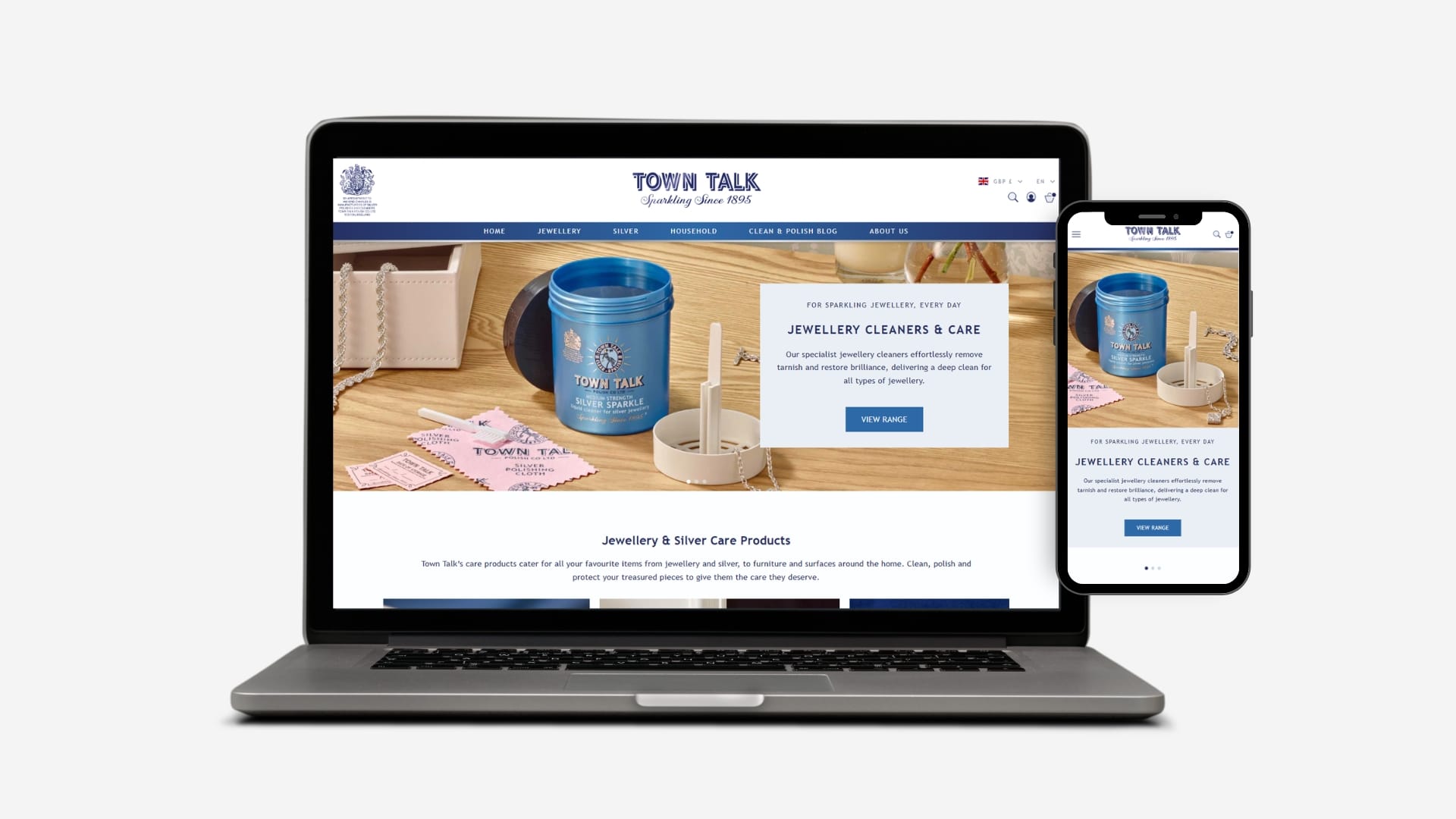
We recently designed and built a refined Shopify site for a heritage jewellery and silver care brand with more than 130 years of history and a royal warrant. The brief was to create a polished consumer storefront that did justice to the craftsmanship and legacy, a gated B2B portal for trade customers, and full internationalisation to support sales across multiple countries.
- Three-warehouse fulfilment. The brand operates from three warehouses globally. We integrated those stock locations into Shopify so orders route to the closest warehouse for each customer, cutting delivery times in their key international markets and reducing shipping costs at the same time.
- Multi-currency support. Customers can browse and check out in their local currency, with prices set deliberately for each market rather than auto-converted from a single base price. That gives the client proper control over margin and over how the brand is positioned in each region.
- French translation via Shopify Translate and Adapt, with more languages to follow. A French version of the site went live as the first localised language, and the early international SEO impact has been tangible, with traffic now arriving from French-language search results in markets where the brand was previously invisible.
- B2B alongside B2C. The gated trade area sits alongside the consumer storefront with its own pricing, ordering rules and account behaviour, so the same Shopify estate serves two genuinely distinct audiences without compromising either.
The thread running through this is that none of these decisions were tacked on at the end. The internationalisation strategy was part of the brief from day one, which is the only way to do it cleanly. Bolting multi-currency, multi-language and multi-warehouse onto an existing single-market site is always more painful than building it in from the start.
Final thoughts
Going international is one of the most genuinely valuable moves an ecommerce brand can make, and one of the easiest to do badly. The brands that succeed treat it as a strategic project that touches every part of the business, rather than a translation pass and a currency dropdown bolted onto an existing storefront.
The good news is the tooling has caught up. Shopify Markets, the Shopify Translate and Adapt app, modern 3PLs and tax-compliance platforms have made it more achievable than ever to run a properly international operation from a single source of truth. The harder work is the upstream thinking: which markets, in what order, with what positioning. Start small, start deliberately, and build the foundations properly. The brands that get this right tend to end up with a cleaner, more disciplined operation in their home market too.
Thinking About Taking Your Store International?
If your ecommerce store is ready to expand into new markets, we would be happy to talk through what a thoughtful internationalisation project looks like for your brand. Our Ecommerce Development services cover everything from Shopify Markets setup and multi-currency pricing through to translations, multi-warehouse fulfilment and the technical SEO that makes international stores actually rank in their target markets.
Sources
- Precedence Research — Cross-Border E-commerce Market Size, Share, Forecast 2025-2034
- Shopify — What is Global Ecommerce? Trends and How to Expand Your Operation (2026)
- Thunderbit — Global Ecommerce Statistics & Trends You Need to Know 2026
- CSA Research — Consumers in 29 Countries: 76% Prefer Purchasing Products With Information in Their Own Language
- SQ Magazine — Cross-Border E-commerce Statistics 2026
- European Commission — E-commerce: 150 EUR customs duty exemption threshold to be removed as of 2026
- Global VAT Compliance — EU low-value customs duty set at 3 euros from July 2026
- FlavorCloud — The End Of The EU De Minimis Era
Related Posts


Get in touch - we're happy to chat.