


Plenty of established brands serve two very different customers at once. There is the retail shopper buying a single item for themselves, and the trade buyer: the stockist, distributor or wholesale account placing larger, repeat orders at their own agreed prices. A B2B ecommerce portal is the part of a website built for that second audience, and getting it right takes a surprising amount of admin off your team while making life far easier for the customers who tend to spend the most.
The shift online is already well underway. According to Allianz Trade, the UK B2B ecommerce market was worth roughly £514.6 billion in 2024, and trade buyers increasingly expect to place and track their own orders rather than waiting on a phone call or an emailed price list. The brands that meet that expectation well end up with a calmer back office and a stickier set of trade relationships.
This guide explains what a B2B ecommerce portal is, the signs your brand is ready for one, the features that matter most, and how to run trade and retail on a single site without either experience feeling like a compromise.
What is a B2B ecommerce portal?
A B2B ecommerce portal is a gated, login-protected area of a website where approved trade customers can browse, order and manage their account at their own contracted prices. It is the online equivalent of the relationship a wholesale customer has always had with a supplier, with the ordering, pricing and history all moved into a place they can reach around the clock.
The word "gated" is the important part. A normal online store is open to anyone, and everyone sees the same public price. A trade portal sits behind a login, and what a customer sees once they are in is specific to them: their pricing, their available products, their past orders and their reordering shortcuts. Approval usually happens first, so a new trade account is reviewed and set up before it can see anything, rather than the prices being on show to the world.
It is worth drawing one distinction early, because the terms get used loosely. A trade portal that belongs to your brand is not the same as a third-party B2B marketplace such as a wholesale directory or trading platform. The marketplace is somebody else's website where you are one listing among many. The portal is your own website, your own pricing logic and your own customer relationship, which is exactly why it is worth building properly.
Signs your brand is ready for a trade portal
Most brands do not decide to build a trade portal in the abstract. They reach a point where the manual way of handling trade orders has started to cost real time and the occasional mistake. A few signs tend to show up together:
- Trade orders arrive by phone, email and spreadsheet, and someone on your team rekeys them into your system by hand.
- Different customers sit on different price lists, and keeping those prices accurate across emails and PDFs has become its own job.
- Reorders are frequent and repetitive, with the same accounts buying the same lines on a predictable cycle.
- Minimum order quantities, case packs or tiered pricing apply, and explaining them each time eats into selling time.
- Your sales team spends more time taking orders than winning them, processing routine purchases that a customer would happily place themselves.
That last point is where the wider data is striking. Research from Gartner found that 61 percent of B2B buyers now prefer a rep-free buying experience for at least part of the journey, and McKinsey's B2B research reports that ecommerce and other self-service channels have overtaken in-person contact as the most effective way for B2B suppliers to generate revenue. Trade buyers are not asking for less service. They are asking for the convenience of placing a routine order at ten at night without needing to catch anyone on the phone.
What a good B2B portal actually does
The features that separate a real trade portal from a basic "log in to see prices" bolt-on are the ones that match how trade customers buy in practice. The most valuable to get right are these:
- Gated access with account approval, so trade pricing is never visible to the public and new accounts are vetted before they go live.
- Customer-specific pricing, where each account, or each tier, sees its own agreed prices rather than a single public list.
- Fast reordering and bulk ordering, including reordering straight from a previous order and adding many lines or SKUs in one go rather than one product page at a time.
- Minimum order quantities and case packs, enforced at the point of ordering so the rules are built in rather than policed afterwards.
- Quotes and negotiated terms, for accounts whose pricing is agreed case by case rather than fixed.
- Order history and self-service accounts, so customers can see past invoices, track current orders and manage their own details.
- Multiple users and delivery addresses per account, which matters for any customer with several buyers or several sites ordering under one umbrella.
- Payment terms and invoicing, including the option to buy on account rather than paying by card at checkout, as much of the trade still expects.
None of these are exotic, but the combination is what makes a portal feel built for purpose rather than a consumer shop with a password in front of it.
One site or two: running B2B alongside B2C
For brands that sell both to the public and to the trade, the central question is whether the two should live on one website or two. Maintaining two entirely separate sites means two sets of products, two sets of stock figures and two builds to keep in step, which is a heavier ongoing burden than most brands expect. The cleaner approach for many is a single platform with a gated trade portal sitting alongside the public storefront, sharing the same product catalogue and the same stock while presenting a different experience to each audience.
The two experiences do need to differ, which is why keeping them distinct matters more than forcing them to look identical:
| Aspect | Retail storefront | Trade portal |
|---|---|---|
| Who can buy | Open to the public | Approved trade accounts only |
| Pricing shown | Single public price | Account-specific or tiered |
| Typical order | One or a few items | Bulk, repeat, multi-line |
| Checkout | Card payment | Card or buy on account |
| Account area | Optional, light-touch | Central to the experience |
Platforms have made this far more achievable than it once was. Shopify B2B, for example, lets a brand run wholesale alongside its consumer storefront from one store, with company accounts, per-customer price lists and payment terms handled as first-class features rather than awkward add-ons. That shared foundation is what keeps stock honest across both audiences and stops the two halves of the business drifting apart.
The technical foundations that make it work
A trade portal lives or dies on what sits behind it. The front end is where the customer logs in and reorders, but the value comes from how well that connects to the systems that already run the business. The foundations worth getting right include:
- Accurate, shared inventory, so the stock a trade buyer sees is the same stock the rest of the business is working from, ideally synced with your warehouse or ERP rather than maintained by hand.
- Pricing logic that scales, so adding a new account or a new tier is a configuration change rather than a development project every time.
- Multi-location fulfilment where it applies, so larger or international trade orders are routed to the right warehouse instead of being shipped from one place regardless of geography.
- Security and access control, because account approval, customer data and contracted pricing all need to be properly protected.

This is the part where template-based or hastily assembled builds tend to come unstuck. They can usually manage the surface, a login and a hidden price, but they struggle with the depth: keeping stock truthful across two audiences, enforcing ordering rules, and connecting cleanly to the systems that fulfil the orders. A portal that shows a trade customer the wrong availability or the wrong price does more damage than no portal at all, so the groundwork is not the place to economise. If you are weighing platforms for this kind of build, our guide to premium ecommerce web design beyond Shopify templates goes deeper on where bespoke work earns its keep.
A real example: a heritage brand selling retail and trade worldwide
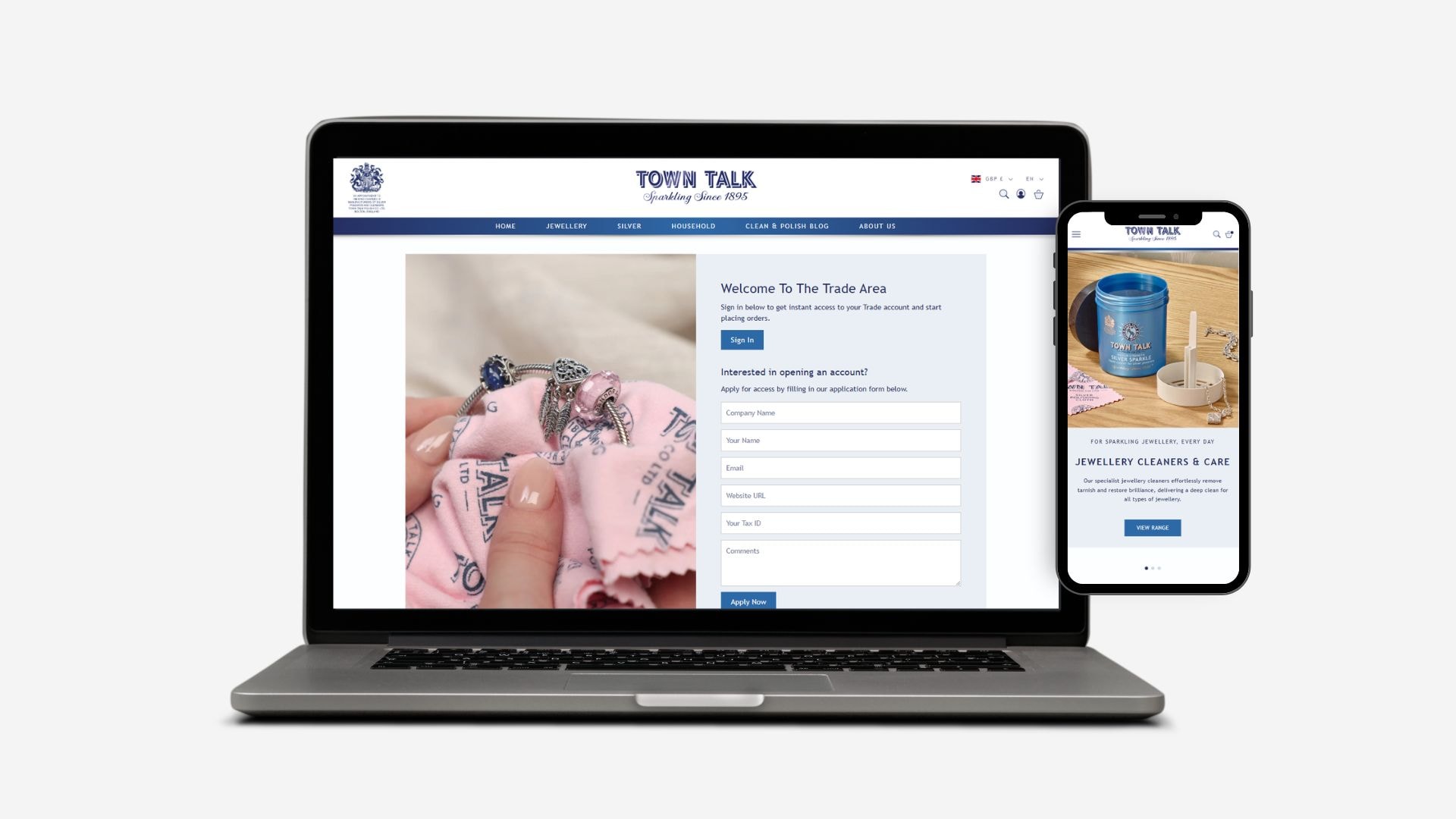
We recently designed and built a refined Shopify store for a jewellery and silver care brand with more than 130 years of history and a royal warrant. The brief asked the same site to do two jobs at once: give retail shoppers a polished, confident route to purchase, and give trade customers their own pricing and ordering, with stock held across several international warehouses.
Rather than bolt B2B on at the end, we built a gated trade portal kept cleanly separate from the consumer storefront, so each audience gets an experience designed for it rather than a compromise between the two. Trade customers sign in to their own area with their own pricing, while the public storefront stays fast and focused on retail conversion. Internationalisation was set up from day one as well, with native currencies per market and several connected stock locations, so the brand could grow into new countries without re-platforming.
You can read the full heritage jewellery Shopify case study for the detail, and our guide to ecommerce internationalisation covers the multi-market side of the same project.
Where trade portals go wrong
The most common mistake is treating the portal as an afterthought, a password dropped in front of a consumer theme rather than a considered build. That tends to surface later as clumsy bulk ordering, pricing that does not scale, and stock figures that disagree with the rest of the business.
The second mistake is quieter and more interesting. It is assuming a portal exists to remove people from the relationship entirely. Gartner's research found that B2B buyers who purchase wholly through self-service are markedly more likely to end up regretting the purchase than those who buy with some human involvement, so the strongest setups treat the portal as something that frees up your team rather than replaces them. The routine reorders move online, and your people spend their time on the conversations that truly need a human: the new account, the complex quote, the customer weighing a larger commitment.
Get those two things right, and a trade portal stops being a cost and starts being infrastructure. It takes the repetitive work off your team, it gives your best customers a faster and more reliable way to buy, and it leaves your people free to do the part of the job that only people can do.
Final thoughts
A B2B ecommerce portal is rarely the flashiest part of a website - its job is to make ordering effortless for the customers who buy the most, to keep pricing and stock honest behind the scenes, and to take a layer of admin off the business that was never a good use of anyone's time.
The brands that get the most from one treat it as a proper project rather than a setting to switch on. They map how their trade customers buy, they build the portal around that, and they connect it cleanly to the systems that fulfil the orders. Do that, and the same website can serve a retail shopper and a wholesale account equally well, without either noticing the other is there.
Thinking About a Trade Portal for Your Brand?
If your business sells to both retail and trade customers, or you are still processing wholesale orders by hand, we would be glad to talk through what a properly built trade portal could look like for you. From Shopify B2B setup and customer-specific pricing to account approval and the inventory integration that keeps the whole thing accurate, get in touch and we will walk you through the options for your brand.
Related Posts



Get in touch - we're happy to chat.