

The Destination-Search Trap: Why Lake District Businesses Are Invisible to Their Best Customers
Most Lake District businesses optimise for the town they sit in. Their best customers search for the destination. Here is how that mismatch costs you bookings and how to fix it without losing local relevance.
Most Lake District business owners get the same advice for showing up on Google: optimise for your town name. Add "Windermere" to your titles, build a Kendal services page, mention Ambleside in the meta description. It is sensible, predictable, and it leaves you invisible to a very large chunk of the audience that should be finding you.
Most of your visitors are not searching for towns. They are searching for the destination. This post is about that mismatch, why it is the single biggest local SEO blind spot for businesses in tourism-heavy regions, and how to fix it without giving up your existing local relevance.
How visitors really search
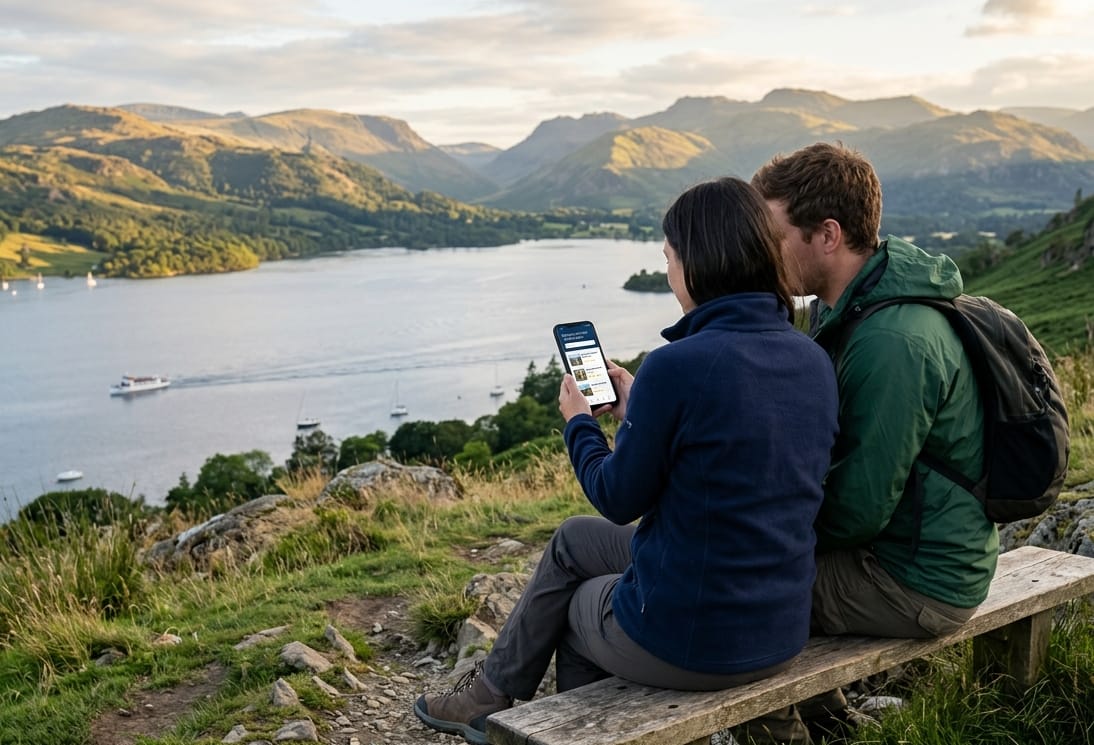
Imagine the journey of someone planning a trip to the Lakes. They live in Surrey, they have a long weekend free in July, and they want to do something memorable. What do they type into Google?
- "things to do in the Lake District"
- "best Lake District holiday cottages"
- "Lake District activities for families"
- "where to stay Lake District"
- "Lake District restaurants with views"
Notice what is missing: town names. Visitors rarely search for "Windermere", "Kendal", "Bowness" or "Keswick" until they have already decided to visit. The early-stage search, when the trip is still being considered, almost always uses the destination, not the individual town.
You can see this clearly in Google Trends. UK-wide search volume for "Lake District" substantially outstrips that of any individual town within it. The same pattern holds in other tourism regions: "Cornwall" outsearches "St Ives", "Snowdonia" outsearches "Betws-y-Coed", "Cotswolds" outsearches "Bourton-on-the-Water". When you optimise only for the town, you are competing for the smaller, later-stage search, and ignoring the much larger pool of earlier-stage prospects.
Why most local SEO advice misses this entirely
The standard local SEO playbook was built for service businesses whose customers are also local. A plumber in Kendal serves Kendal residents. A dentist in Windermere serves Windermere residents. For those businesses, optimising for the town is exactly right.
Tourism businesses are the opposite. Your audience does not live nearby. They live in cities across the country, planning a visit, comparing their options before they have even chosen which town to base themselves in. Telling them you are the "best café in Windermere" only matters once they have already decided that Windermere is where they are going.
For everything before that decision, the question they are answering is "where in the Lake District should we go?" - and that is where your invisibility costs you most. By the time someone searches "Windermere restaurants", they are already in the village. You have probably already lost them to whoever helped them choose Windermere in the first place.
Cumbria, the county the Lake District sits within, falls into yet another bucket. It is the term used more by locals, residents, and business buyers than by holiday planners. A Carlisle plumber serving Cumbria-wide customers should target "Cumbria"; a Bowness café serving Lake District visitors should target "Lake District". They are different audiences with different search intent, and conflating them is where a lot of confused local SEO comes from.
The two audiences your tourism business needs to court
Tourism businesses have two distinct audiences with completely different search behaviour:
- Pre-trip planners. Searching from home, weeks or months ahead, using destination-level terms like "Lake District", "Cumbria", or "Lakes weekend". They are deciding where to go, what to do, and where to stay. This is where bookings, longer stays, and higher-value visits come from.
- In-region visitors. Already on holiday, looking for what to do today, using local terms like "best lunch Bowness" or "things to do Keswick today". This is where smaller, spontaneous purchases come from.
Most Lake District businesses only show up reliably for the in-region audience, because that is what their SEO targets. They are missing the planner audience entirely, which is usually a larger group, has higher intent, and converts to bigger bookings.
Think of it as the difference between catching someone who has already decided to spend money in your area, and catching someone who is still deciding whether to visit at all. Both are worth winning. Most businesses only optimise for the easier half.
How to target destination searches without losing local relevance
The good news is that you do not have to choose. With a deliberate content and SEO structure, you can rank for both the destination and the town-level searches at the same time.
A few practical principles:
- Lead with the destination, then bring it home. A page titled "things to do in Bowness" might rank for the town-level search but never the planner search. The same content reframed as "things to do in the Lake District: a guide to Bowness-on-Windermere" can rank for both. The destination is in the title, the town sits in the subtitle and body.
- Build genuine destination guides. Not thin "Lake District" landing pages stuffed with keywords, but real guides: a family-friendly Lake District itinerary, a guide to the best Lake District lakes for swimming, a comparison of Lake District towns for couples versus families. These attract pre-trip planners and naturally include your business as one of the recommendations.
- Mention the destination naturally in your service or accommodation pages. A holiday let's page does not need to say "Lake District" forty times, but if every page describes the property only by its town, you are signalling to Google that the destination is not what you are about. Mention it once or twice where it fits.
- Build a "near" structure. "Near Lake Windermere" or "near Ambleside" is more useful in titles and headings than just the town name alone, because it catches the destination-aware searcher while staying precise.
Content that captures pre-trip planning
If you only build one new piece of content this quarter, build a proper destination guide. Not a generic "welcome to the Lake District" page, but something specific, useful, and unmistakably written by someone who knows the area.
A few formats that consistently perform:
- "A weekend in the Lake District: itinerary for first-time visitors / families / couples / hikers". These rank well because almost nobody is writing them properly, and the people searching them are usually about to book a trip.
- "Best [thing] in the Lake District" lists. Best lakes, best walks, best afternoon teas, best fish and chips, best pubs by the water. These attract substantial traffic and let you naturally include your own business as part of the answer.
- "Hidden Lake District" or "off the beaten path Lake District". These rank for repeat visitors who have already seen the obvious spots and are looking for something new.
- Comparison content: "Windermere or Keswick - which is right for your trip?" These rank for planners actively choosing between towns and are some of the highest-converting pages you can build.
Critically, these are not posts to write once and forget about. The businesses that gain most are the ones that update them every season and respond to the comments and questions they attract.
Practical implementation - what to add this week
If you want to start moving the needle without committing to a full content overhaul, three short steps:
- Audit your existing titles and metadata. Find any page where the title only mentions a town. For each one, decide whether including "Lake District" or "Cumbria" would broaden its reach without making it less truthful. Update the ones that fit.
- Add a single destination-level page to your site. A guide, an itinerary, or a comparison. Whatever fits your business naturally. Make it useful enough that someone planning a trip would bookmark it. Internal-link from it to your individual location or service pages.
- Update your Google Business Profile description. Most Lake District businesses describe themselves entirely in town-level terms. Mention the destination once in the description, in a way that fits naturally. Google reads these descriptions and uses them for query matching.
These three steps take less than half a day in total and start signalling to Google that you are part of the destination, not just the town.
Final thoughts
The destination-search trap catches more Lake District businesses than any other local SEO mistake we see. Your customers are searching for the place. You are optimising for the postcode. The fix is not to abandon local SEO, it is to expand it.
Plenty of Lake District businesses look reasonable in a Bowness or Keswick search but vanish entirely when someone searches for the Lake District itself. The businesses that have addressed this consistently outperform their neighbours, not because their websites are better, but because they are visible in searches the competition never thought to compete for.
We covered some of the related conversion-side mechanics in our earlier piece on how Lake District tourism businesses can drive more direct bookings - worth reading alongside this one.
Need a Second Opinion on Your Lake District Visibility?
If you would like an honest look at how your business shows up for destination searches and where the biggest opportunities are hiding, our SEO and Marketing service starts with a free audit. We will tell you what is worth your time and what is not, and only recommend work where the impact is worth the spend. And if the website itself is the weak link, we build websites for Lake District businesses designed around exactly this kind of destination search, as part of our wider web design work across Cumbria.
You can also book a free discovery call to talk it through.
Related Posts

Get in touch - we're happy to chat.